
Introduction
If there has been one constant thread running through my personal and professional life, it has been my dual devotion to grappling and philosophy.1 On the surface, these disciplines seem to stand at complete opposite poles of the human experience: one forged through sweat, friction, and physical struggle; the other through reflection, argument, and rational inquiry. Yet for me, they have always belonged together; as two manifestations of a singular pursuit of truth. Whether on the wrestling mat or in the philosophy classroom, both practices push one toward something clearer, stronger, and more real. They illuminate the external world beyond the self and the interior life within it.
Recognition of this union is hardly unprecedented. Ancient Greek thinkers, Stoics, Samurai traditions, and many contemporary philosophers and martial artists have recognized the intimate relationship between martial practice and philosophical contemplation. Still, within today’s fragmented culture, where many inhabit lives of either sedentary intellectualism or anti-intellectual physicality (or neither), the idea that grappling and philosophy might be mutually reinforcing and mutually informative appears antiquated, implausible, or even unworthy of serious consideration.
That said, the purpose of this essay is therefore, twofold. First, it is to articulate how philosophy and grappling actually complete one another. Each pursuit offers what the other lacks: philosophy clarifies aims, concepts, and ideals of human flourishing, while grappling tests these ideals in the non-ideal world and cultivates the habits of mind and body necessary for real human excellence. Second, I aim to show how these complementary disciplines of grappling and philosophy are not merely conducive to flourishing in general, but are especially critical for the formation of ethical military leaders and future warrior-scholars. To motivate these aims, we must first turn to the deeper philosophical roots of the classical mind-body unity.
Historical Roots: Sound Mind in a Sound Body
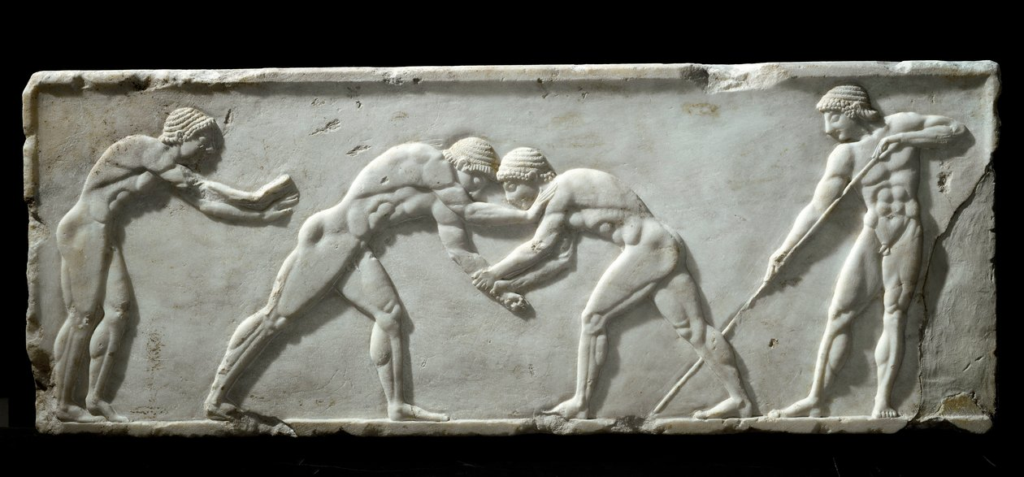
The stark separation between intellectual and physical excellence so common today would have been utterly foreign to the ancient Greeks and Romans. For thinkers such as Socrates, Plato, and Aristotle, the idea that a person could cultivate the mind while neglecting the body; or vice versa; was not merely odd but incoherent.
Socrates, the founder of ethics, was both a philosopher and a wrestler, known in his youth for his toughness and courage in battle.2 His most famous student, Plato, was likewise a wrestler; ‘Plato’ meaning ‘broad-shouldered’, referencing his wrestling nickname.3 In his famous work The Republic, Plato insists that the guardians of his ideal city must equally study mathematics, logic, and music (to develop the soul) as well as gymnastics (to develop the body).4 His real-world school, The Academy, founded in Athens, fostered both.
Aristotle, Plato’s most famous student and tutor to Alexander the Great, pushed this unity even further. He described humans as “embodied rational animals,” a single, inseparable unity of soul and body. His metaphysical view, hylemorphism, rejected the later modern Cartesian idea of a radical metaphysical separation between mind and body.5 For Aristotle, knowledge arises not solely from abstract reasoning but from embodied experience: how we perceive, move, struggle, and form habits in the physical world. His rival school to Plato’s, The Lyceum, reflected this worldview, offering learning environments for the development of both intellectual excellence as well as physical capability.
The Romans later captured a similar insight in their famous maxim mens sana in corpore sano or ‘a sound mind in a sound body.’ Intellectual virtue and physical discipline, for their culture, were likewise understood not as rivals but as mutually reinforcing components of human excellence.
This same conviction appears throughout Eastern martial traditions as well. In The Book of Five Rings, Miyamoto Musashi emphasizes that mastery of the sword depends on mastery of the self; technique is inseparable from clarity, calm perception, and inner equilibrium.6 Jigoro Kano, founder of Judo, likewise envisioned his art as a holistic philosophy of education aimed at mutual welfare, personal refinement, and disciplined self-mastery. For Kano, the dojo was not merely a training hall but a crucible for producing moral citizens.7
Across these traditions runs a single, enduring belief: that cultivating human excellence requires cultivating both mind and body equally.
Today, wrestling rooms and jiu-jitsu gyms remain among the few modern environments where this insight endures. These spaces confront us with objective reality; where wishful thinking, rhetorical cleverness, or ideological abstractions collapse against the resistance of another human will. A rear naked choke does not care about your feelings; hyperextended joints are not social constructions. As thinkers like Thomas Sowell, Matthew B. Crawford, and Nassim Taleb have all emphasized, human beings oscillate between idealized models and the non-ideal world we actually inhabit.8 Grappling forces intimate contact with the latter.
How Philosophy and Grappling Intersect
Philosophy and grappling overlap most powerfully in three domains: virtue ethics, virtue epistemology, and cultural formation. Each area highlights how these practices work together to shape character, intellect, and communities of trust.
1. Virtue Ethics: The Formation of Character
Virtue ethics, rooted in Aristotle, holds that good character arises not through theoretical knowledge alone but through habituated practice. Courage, temperance, justice, and prudence become ours by performing difficult acts intentionally, repeatedly, and under the right guidance.
Grappling is a natural school for these virtues. It cultivates:
- Courage, by requiring engagement despite fear and risk.
- Temperance, through controlling aggression and ego.
- Perseverance, through enduring discomfort, fatigue, and repeated failure.
- Humility, by confronting better, stronger, or more experienced opponents.
- Justice, by honoring rules, respecting opponents, and recognizing earned merit.
The mat therefore becomes a laboratory for moral development: every tap, escape, sweep, or failure offers feedback that shapes one’s character; courage and temperance free the will to act justly. Grappling thus becomes not merely a sport or martial art, but an apprenticeship in virtuous living.
2. Virtue Epistemology: Knowing Well Through Embodied Reality
Virtue epistemology studies not just what knowledge is but how to cultivate the intellectual virtues and habits of mind needed to acquire it responsibly: epistemic humility, self-honesty, attentiveness, open-mindedness, and epistemic courage.
The grappling mat trains these virtues with ruthless clarity. Overconfidence gets you swept; inattention gets you mounted; dogmatism leads to stagnation; ego leads to injury. Grappling therefore enforces a form of epistemic realism and constantly reminds its practitioners of an important and enduring lesson: that reality pushes back.9
Furthermore, grappling also reveals the difference between what philosophers refer to as knowing that versus knowing how.10 For instance, someone might be able to memorize the definition of courage and ‘know that’ the concept of courage has something to do with being neither reckless nor cowardly. But without embodied practice, that person will never truly ‘know how to’ let alone ‘be’ courageous. Rather, it is only through repeated practice does such conceptual head knowledge translate into lived and embodied attributes incorporated into and made part of the constitution of the actual practitioner, what philosopher Merleau-Ponty referred to as “knowledge in the hands.”11 The discipline of grappling forces this translation and fusion of intellectual understanding and embodied skill; an essential union necessary for any form of mastery.
3. Cultural Formation: Building Trust and Community
Grappling rooms are micro-communities built on trust, mutual struggle, and excellence. They cultivate meritocracy, shared standards, and reciprocal accountability. You tap when caught; you train and compete honestly and fairly; you safeguard your partner’s body as well as your own.
This mirrors what philosopher Alasdair MacIntyre describes as a “tradition-constituted practice”; a community governed by internal goods, shared standards, and a lineage that shapes its practitioners.12 Grappling’s rituals, courtesies, and history remind individuals that they participate in something much larger than themselves.
In short, grappling is not just physical training but cultural formation grounded in trust, humility, and excellence.
The Modern Divide and the Return to Embodiment
The unity of mind and body began to first fray with the rise of Cartesian dualism at the outset of the Enlightenment, followed thereafter by the Industrial Revolution’s shift toward increasingly sedentary labor, and now, most recently, with the fast rise of the Digital Age. Many people now inhabit evermore sedentary lives increasingly filtered through screens, abstractions in the head, online narratives, and digital noise that seldom force confrontation the non-negotiable constraints of the physical world in any meaningful way whatsoever.
Grappling offers an immediate remedy to this lamentable state of affairs. For it restores a form of existential contact with reality; what William James referred to as ‘the experience of activity.’13 Philosophy then interprets that experience, clarifying its meaning. Together, both disciplines, working in tandem, re-establishing a unified mode of being that modern culture most desperately needs.
Relevance to Ethical Leadership and Officer Formation
The synthesis of philosophy and grappling becomes especially urgent in forming competent and ethical military officers. Officers must think clearly under pressure, embody moral courage, and foster trust within their units. Philosophy provides the conceptual frameworks for ethical judgment; grappling provides embodied training in navigating friction and uncertainty.
Three areas are especially relevant here.
1. Embodied Moral Agency: The Martial Virtues in Command
Officers must possess virtues such as discipline, courage, temperance, loyalty, and controlled aggression. Grappling cultivates these physically, while philosophy clarifies their meaning and moral limits.
Philosophy prevents physical virtue from devolving into brute force by examining questions such as:
- What is the proper use of power?
- What does ethical restraint look like under threat?
- How should one balance courage with prudence?
Grappling trains the body to act decisively; philosophy ensures those actions align with justice and what is true.
2. Judgment Under Friction: Combat Epistemology
Clausewitz famously described the “fog and friction” of war; uncertainty, chance, and chaos.14 Grappling simulates such fog and friction in microcosm: rapid decision-making under exhaustion, imperfect information, and active resistance. You must stay calm, adaptive, and aware despite discomfort.
Philosophy complements this by training:
- logical reasoning,
- conceptual clarity,
- ethical analysis, and
- the ability to distinguish appearance from reality.
Together, they develop officers capable of making sound judgments in morally and operationally ambiguous environments.
3. Building Cohesive Ethical Units: Trust, Tradition, and Shared Struggle
Just as the dojo forms practitioners within a living tradition, military units depend on shared hardship, earned trust, and common standards. Grappling provides a vehicle and model of a meritocratic, trust-based culture; philosophy clarifies the moral purpose of such a culture.
Philosophy articulates why trust matters: because leaders bear responsibility not only for mission success but for the lives, dignity, and moral well-being of those under their command. Grappling provides embodied encounters with trust; partners must protect one another even while testing each other.
Together, they forge leaders capable of cultivating ethical, cohesive units.
Conclusion
Grappling and philosophy both illuminate essential dimensions of the human condition. Grappling reveals the non-ideal world of resistance, conflict, and physical limits; philosophy reveals our role as rational and moral agents who must understand that world, and act well within it. Each discipline is fundamentally incomplete without the other. A classroom without a dojo risks becoming detached and impotent; a dojo without a classroom risks becoming brutish and directionless.
Together, however, they create whole persons; equally discipled in thought and action, humility and courage, rationality and resilience. This integration helps to cultivate the ‘warrior-scholar’: the individual capable of disciplined physical action, rigorous reasoning, honest self-assessment, and service grounded in moral truth.
In essence, both grappling and philosophy teach the same perennial lesson: that an objective world exists beyond the limits of our own personal desires and individual subjectivity. Accordingly, whether encountered through physical resistance or rational argumentation, and whether we know it or not at the time, contact with the contours of that objective world, even if they feel sharp or uncomfortable in the moment, always ultimately shape us for the better in the end. Through repeated and honest contact with this world, we develop the virtues necessary for ethical leadership, responsible power, and a life ordered towards the good; a good both worthy of defense and thereby generative of its defenders.
1 I model this article off of Richard R. Eva’s most excellent essay “Wrestling with Philosophy,” to which I
am truly indebted. See “Wrestling with Philosophy,” Public Discourse, August 8, 2021,
https://www.thepublicdiscourse.com/2021/08/77088/
2 Neel Burton, “Socrates at War: Philosopher and Soldier,” Psychology Today, September 19, 2025,
https://www.psychologytoday.com/us/blog/hide-and-seek/202307/socrates-at-war-philosopher-and-soldier
3 Eva, “Wrestling with Philosophy.”
4 Plato, Republic, trans. G. M. A. Grube, rev. C. D. C. Reeve (Indianapolis: Hackett Publishing, 1992),
Books II–III.
5 Aristotle, Metaphysics, trans. W. D. Ross, in The Complete Works of Aristotle, vol. 2, ed. Jonathan
Barnes (Princeton: Princeton University Press, 1984), Book VII; see also Physics, Book II, on
hylomorphism and nature.
6 Miyamoto Musashi, The Book of Five Rings, trans. Thomas Cleary (Boston: Shambhala Publications,
1993).
7 Jigoro Kano, “The Contribution of Judo to Education,” in Mind Over Muscle: Writings from the Founder of
Judo, ed. Naoki Murata (Tokyo: Kodansha International, 2005); Nassim Nicholas Taleb, Antifragile: Things
that Gain from Disorder (New York: Random House, 2012.)
8 See Thomas Sowell, Intellectuals and Society (New York: Basic Books, 2010); Matthew B. Crawford,
Shop Class as Soulcraft (New York: Penguin Press, 2009);
9 For an extended argument on the relationship between grappling and virtue epistemology see
Peter Boghossian, Allison White, Dustin Sanow, Travis Elder, and James Funston, “Critical Thinking,
Pedagogy, and Jiu Jitsu: Wedding Physical Resistance to Critical Thinking,” Radical Pedagogy 14, no. 1
(2017), https://pdxscholar.library.pdx.edu/phl_fac/32/
10 Jason Stanley and Timothy Williamson, “Knowing How,” The Journal of Philosophy 98, no. 8 (2001):
411–444.
11 Maurice Merleau-Ponty, Phenomenology of Perception, trans. Donald A. Landes (New York: Routledge,
2012), esp. Part I, ch. 3.
12 Alasdair MacIntyre, After Virtue, 3rd ed. (Notre Dame, IN: University of Notre Dame Press, 2007), ch.
13 William James, “The Experience of Activity,” in Essays in Radical Empiricism (New York: Longmans,
Green, and Co., 1912), 161–66.
14 Carl von Clausewitz, On War, trans. Michael Howard and Peter Paret (Princeton: Princeton University
Press, 1976), Book I, ch. 7.
*The author used ChatGPT to revise this essay