Introduction
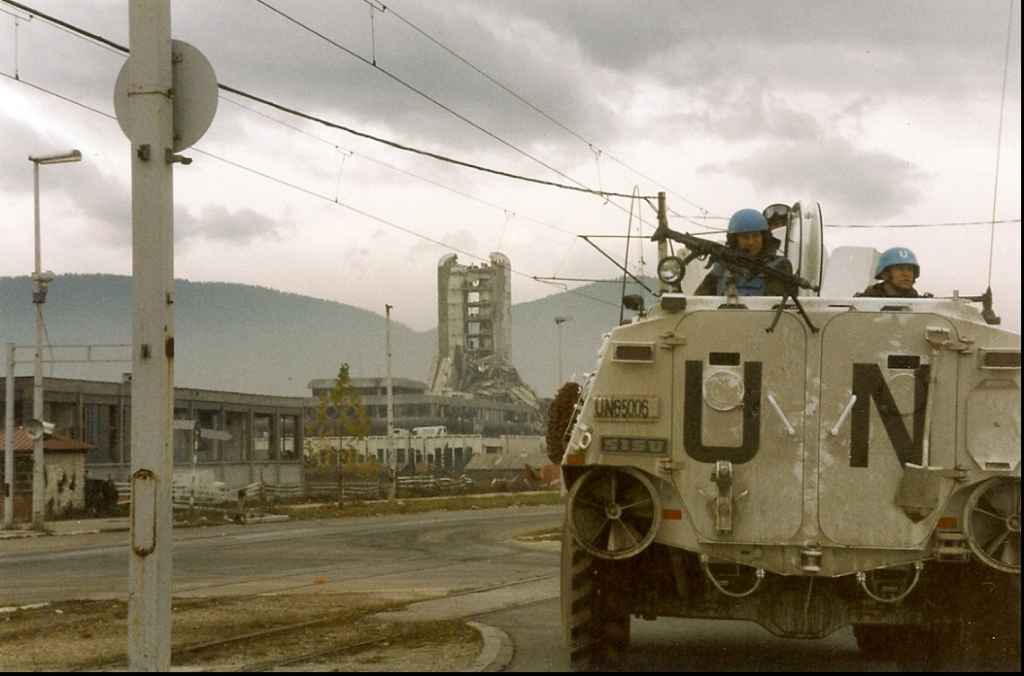
In 1992, Bosnia declared independence from Yugoslavia, following in the footsteps of Croatia and Slovenia, who had done the same the previous year. Bosnian Muslim control over the new government immediately upset the large Bosnian Croat and Serb minorities in the country. With support from Croatia and Yugoslavia (Serbia), the Bosnian Croats and Serbs soon took up arms against the Bosnian Muslims with the hopes of joining the nations of their ethnic brethren. What resulted was pure chaos in the Balkans. It was a three-front civil war inside of a civil war; neighbors were shooting at neighbors, and atrocities were common on all sides. Western media became quickly entrenched in this struggle, and broadcast the conflict’s horror to the world. Soon, the United Nations would impose economic and diplomatic sanctions on Yugoslavia, while also engaging in extensive humanitarian aid efforts throughout the war. Eventually, the international response would dramatically escalate in 1994 as UN-approved NATO airstrikes would fall on Serb positions around the Bosnian Capital of Sarajevo. Again in 1995, after the Serbs would murder thousands of Bosniaks in an obvious act of genocide, NATO began a comprehensive bombing campaign that would eventually lead to the Dayton Accords and an end to the conflict. Via their continued coverage and narrative-building during the war, the media would play an undeniable role in the transition of the conflict from civilian aid to military action. This shift was done intentionally; the Western crusade against the Serbs was led by the journalists who were on the ground during the conflict. Journalists saw the horror on the ground and believed it was their duty to convince the world to intervene. In service of this aim, there became a degradation in the media of standards of honesty when reporting certain events. The behavior of the media during the Yusgoslav wars demonstrates how infusing journalism with ethical narratives can result in misleading reporting and harmful ramifications on a large scale.
Journalism of Attachment
The journalists who reported on the Yugoslav conflict were exposed to immense human suffering, and they saw their platform as a way to help resolve it. Martin Bell was a BBC reporter during this time, and what he saw fundamentally shifted his view on the role of journalism in society.
“In place of the dispassionate practices of the past, I now believe in what I call the journalism of attachment. By this I mean a journalism that cares as well as knows; that is aware of its responsibilities; that will not stand neutrally between good and evil, right and wrong, the victim and the oppressor… We exercise a certain influence, and we have to know that” (Bell, 2009).
By becoming “attached” to the Bosnian conflict and its horror, many journalists developed a personal sense of responsibility for changing the situation on the ground. Scholar Nel Ruigrok likened Journalism of Attachment to a more extreme version of public journalism, which is a media style described as, “a theory and a practice that recognizes the overriding importance of improving public life” (Ruigrok, 2008). In a genuine attempt at improving the lives of the Bosnians and the world as a whole, the media began presenting issues as less objective, embracing this “Journalism of Attachment” and projecting into American households a narrative that would trigger an emotional response and a drive for intervention. This narrative would inevitably degrade some of the journalistic integrity around the war. Media narratives grounded in “attachment” or “public good” can ironically spiral away from fairness and honesty, despite their ethical intentions. This type of reporting is dangerous because of how effective it is at creating a will to violence, regardless if truth is being told. The media’s ability to increase public willingness for military action is often cited as the “Do Something Effect” and was used effectively in the Yugoslav context for the eventual intervention by NATO.
The “Do Something” Effect
The “Do Something” effect is described by Karin von Hippel and Michael Clarke as the unification of national interests, political willpower, and media attention into tangible political pressure that heavily influences the decisions of government actors. When discussing the history of American military intervention, the two scholars write:
“In all these cases the period leading up to the intervention was marked by inconsistent policy, public waffling, and successive threats… It is difficult for democratic states to avoid such preliminaries. As Bruce Russett puts it, ‘In the absence of direct attack, institutionalized checks and balances make democracies’ decisions to go to war slow and very public’ ” (von Hippel and Clarke, 1999).
In democracies, the use of military force is difficult to muster bureaucratic and political support for, usually making it a last resort after failed economic and/or diplomatic sanctions. Without the “Do Something” pressure, it can be difficult to motivate the government to overcome the political slog induced by questions of military action.
To overcome this delay during the Yugoslav conflict, the media infused their reporting with emotional and ethical narratives of Bosnian oppression. Karin von Hippel and Michael Clarke write how, “Extensive television coverage of all these crises, and the ensuing public outcry, has had a significant impact and forced policy makers to react” (ibid). At some points during the war, there was as high as 59% support for US airstrikes in Serbia and 67% support for US ground troops intervening to get food and medicine to Bosnian civilians (Sobel, 1998). Wide-spread practice of the Journalism of Attachment had successfully infused emotional and ethical narratives into the minds of the American people, and won their support for “Doing Something” violently.
The Deterioration of Truth in Bosnia
While the journalists had good intentions in Bosnia, the media’s emotional bias toward the Bosnian side would lead to several instances of truth manipulation. One such case occurred on February 5, 1994, during the Bosnian Serb siege of Muslim Sarajevo. That day, a mortar strike killed 66 people and injured 200 more in what became known as the First Markale Massacre. Five subsequent investigations of the crater would be conducted from February 5-15, that together “left open the question of responsibility” (Rusek, Benjamin, and Charles Ingrao, 2004). Even so, the media would make a concerted effort to convince the public of Serbian responsibility for the attack. One day later, New York Times foreign correspondent John Kifner would write the following in an article:
“It was the second heavy casualty toll in two days from the Serbian artillery on the mountains ringing the city… although the exact origin could not yet be determined… Bitter frustration with the failure of the United Nations and Western diplomacy and mediation to have any effect on halting the nearly two years of indiscriminate shelling of Sarajevo by Bosnian Serb forces spilled out today as survivors screamed at foreign journalists at the scene” (Kifner, 1994).
The writer directly assigns blame to the Serbian forces, despite acknowledging that the true perpetrator was still unknown. The piece also references the failure of diplomatic efforts at ending the slaughter, which calls the reader to push for increasing global intervention. A similar, though more subtle, bias is evident in a piece written for the Washington Post by Tony Smith on the same day as the shelling,
“[Bosnian] President Alija Izetbegovic’s spokesman, Kemal Muftic, charged that the 120mm mortar shell was fired from a Serb-held position north of Sarajevo. Bosnian Serb leader Radovan Karadzic, however, suggested that government soldiers had fired on their own people to persuade NATO to go ahead with threatened airstrikes on Serb positions. But there was no evidence to support his charge, which was dismissed by the Bosnian government” (Smith, 1994).
In this article, the Bosnian Muslim narrative goes unchallenged, while the Serb narrative is clarified as having “no evidence.” It might have been true that there was no evidence for either side being responsible, but that by no means exonerated the Bosnian side, as the article seems to imply.
Later UN investigations would confirm that the Serbs fired the shell (Report of the Secretary-General, 1999). However, the journalists had no way of knowing that at the time of their writing, yet they still used rhetoric that would convince their readers of Serbian guilt. In neither Smith’s nor Kifner’s article is there an absolute fabrication of facts, but they still weren’t totally honest either. They bent the truth and this was because their reporting was meant to serve a different purpose than the objective resuscitation of facts. The reporting was manipulated because the journalists felt that reinforcing the larger narrative of Serbian evil was more important than reporting the absolute truth. While this Journalism of Attachment might have saved many Bosniak lives via the military intervention, it is a dangerous example of how conflating ethical activism and journalism can lead to a deterioration of journalistic integrity, even in a well-meaning circumstance.
Consequences in the Modern Day
Since the Yugoslav wars, social media has only continued the trend of narrative manipulation and dishonesty. A study by Patrick Kennedy and Andrea Prat in 2019 compared different sources of media and their impact on elections. Facebook was ranked at a stunning 2nd overall in influence–over ABC, CBS, and the New York Times (Kennedy and Prat, 2019). The scope and lack of accountability present on social media makes this influence exceptionally dangerous. Each user can practice Journalism of Attachment, reach millions of people, and not suffer consequences. The same ethical rhetoric used by the media to inspire the intervention against Serbia could be used to inspire Americans to violence among themselves or innocent others. Narratives can generate change and be a powerful tool for good, as we witnessed in the Yugoslav wars. However, violent, untruthful narratives that contrast each other can pose a serious threat to American longevity if we become convinced to “Do Something” against each other. Americans are admirable in that we are willing to fight evil and those who support it, but we must still champion objectivity in media reporting, or else one day it might be us in a three-front civil war inside of a civil war, with neighbors shooting at neighbors.
Sources
Bell, Martin. “The Journalism of Attachment.” In Media Ethics, edited by Matthew Kieran, 23-45.
Oxford: Oxford University Press, 2009.
Binder, David. “Anatomy of a Massacre.” Foreign Policy, no. 97 (1994): 70–78.
https://doi.org/10.2307/1149440.
Kennedy, Patrick J., and Andrea Prat. “Where Do People Get Their News?” Economic Policy 34, no. 97
(2019): 5–47. https://www.jstor.org/stable/26735410.
Kifner, J. (1994, February 6). 66 Die as Shell Wrecks Sarajevo Market. New York Times.
https://www.nytimes.com/1994/02/06/world/66-die-as-shell-wrecks-sarajevo-market.html
Rusek, Benjamin, and Charles Ingrao. “The ‘Mortar Massacres’: A Controversy Revisited.” Nationalities
Papers 32, no. 4 (2004): 827–52. https://doi.org/10.1080/0090599042000296140.
Report of the Secretary-General pursuant to General Assembly resolution 53/35 The fall of Srebrenica.
(1999). In Security Council Report (A/54/549). United Nations General Assembly. Retrieved September 3, 2025, from https://www.securitycouncilreport.org/atf/cf/%7B65BFCF9B-6D27-4E9C-8CD3-CF6E4FF96FF9%7D/a_549_1999.pdf
Ruigrok, Nel. 2008. “Journalism of Attachment and Objectivity: Dutch Journalists and the Bosnian War.”
Media War & Conflict 1 (3): 293–313. https://doi.org/10.1177/1750635208097048.
Smith, T. (1994, February 5). SHELLING OF SARAJEVO MARKET KILLS 66, WOUNDS
HUNDREDS. The Washington Post.
https://www.washingtonpost.com/archive/politics/1994/02/06/shelling-of-sarajevo-market-kills-6
6-wounds-hundreds/e609f25a-a855-4a11-bd28-546eb3561917/
Sobel, Richard. “Trends: United States Intervention in Bosnia.” The Public Opinion Quarterly 62, no. 2
(1998): 250–78. http://www.jstor.org/stable/2749625.
von Hippel, Karin, and Michael Clarke. 1999. “Something Must Be Done.” The World Today, March.
MIDN 2/C Gavin Bannister is a member of the Class of 2027. He is a Political Science major in 4th Company. His home town is Bristol, Vermont and he hopes to commission as a Surface Warfare Officer. He is an active member of the Naval Academy Foreign Affairs Conference, the Log, and USNA’s Drum and Bugle Corps.